Most "natural" skincare isn't. Here's exactly what goes into our herbal-infused whipped tallow balm, what we leave out, and why the difference shows up on your skin.
Pick up almost any skincare product on a store shelf — even the ones marketed as natural, clean, or organic — and read the back label. You'll find a list of fifteen, twenty, sometimes thirty ingredients. Stabilizers. Emulsifiers. Preservatives. Fragrances. Phenoxyethanol. Tocopheryl acetate. Carbomer. Names that don't sound like food because they aren't food, and your skin treats them accordingly.
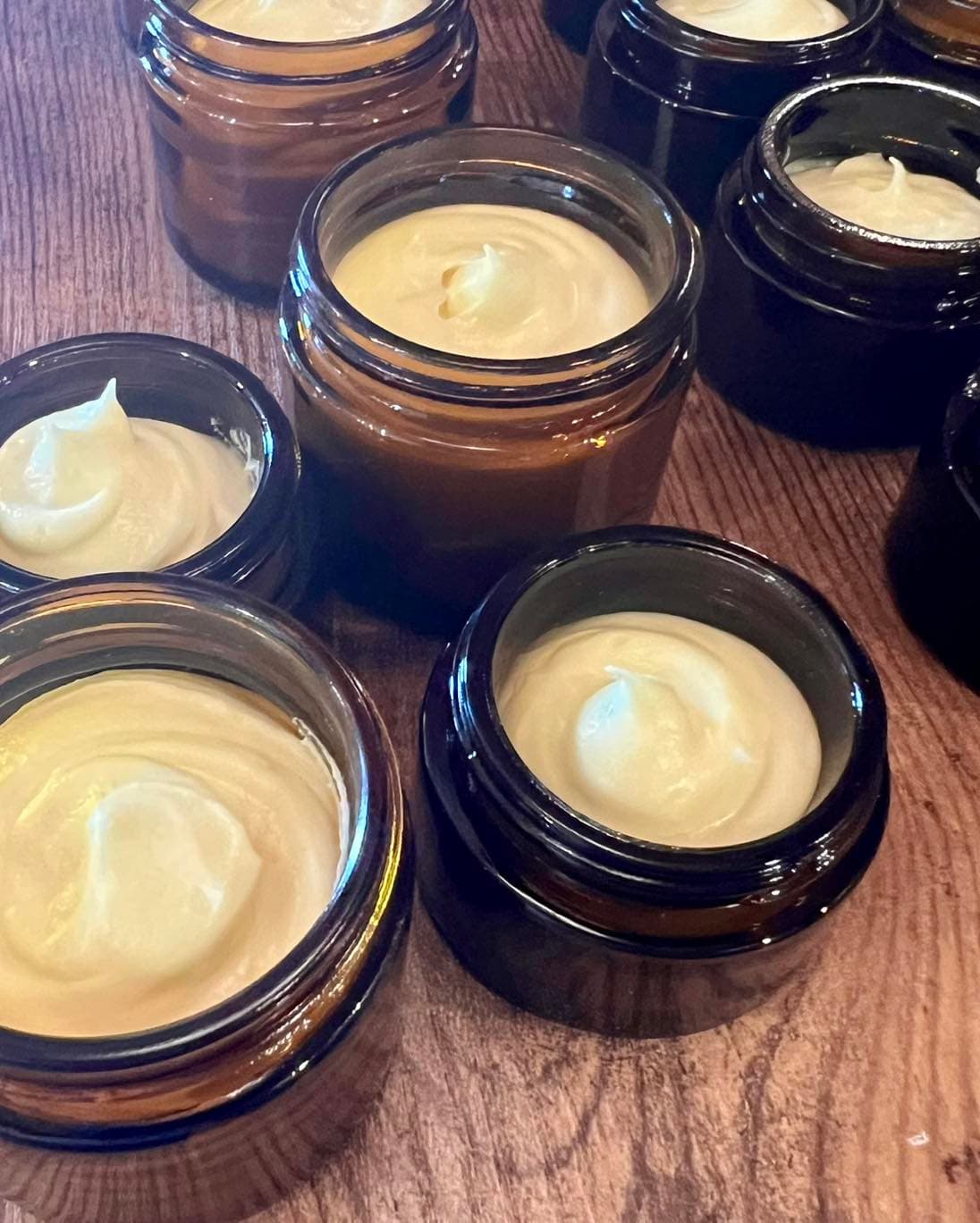
Now look at the back of one of our whipped tallow balm jars. You'll find five ingredients or fewer. All of them you can pronounce. All of them you could grow, render, or press yourself. That's not a marketing decision. It's just what the product actually is.
What's In It (The Whole List)
Here's everything that goes into our whipped tallow balm. Nothing else. Ever.
100% grass-fed beef tallow — rendered from our own cattle herd at Deer Run Acres.
Organic jojoba oil — for spreadability and absorption.
Organic herbs, coffee, or vanilla — depending on the blend, infused into the jojoba oil before whipping.
That's it. Three categories of ingredient. Five items or fewer on any given label. No beeswax. No essential oils. No fragrance. No preservatives. No emulsifiers. No "natural flavoring." No fillers.
If that sounds simple, it's because it is. Skin doesn't need complexity. Skin needs the right materials. And the right materials, in our opinion, are the ones the human body has been recognizing as food for tens of thousands of years.
The Tallow: Why Ours Is Different From Almost Every Other Tallow on the Market
Most tallow products you can buy — even from small companies and farm brands — share two problems: the source isn't fully traceable, and the rendering process isn't taken far enough. The result is tallow that smells beefy, develops off-flavors, eventually goes rancid, or has to be stabilized with additives like beeswax or vitamin E to keep it from turning.
Ours doesn't have either problem.
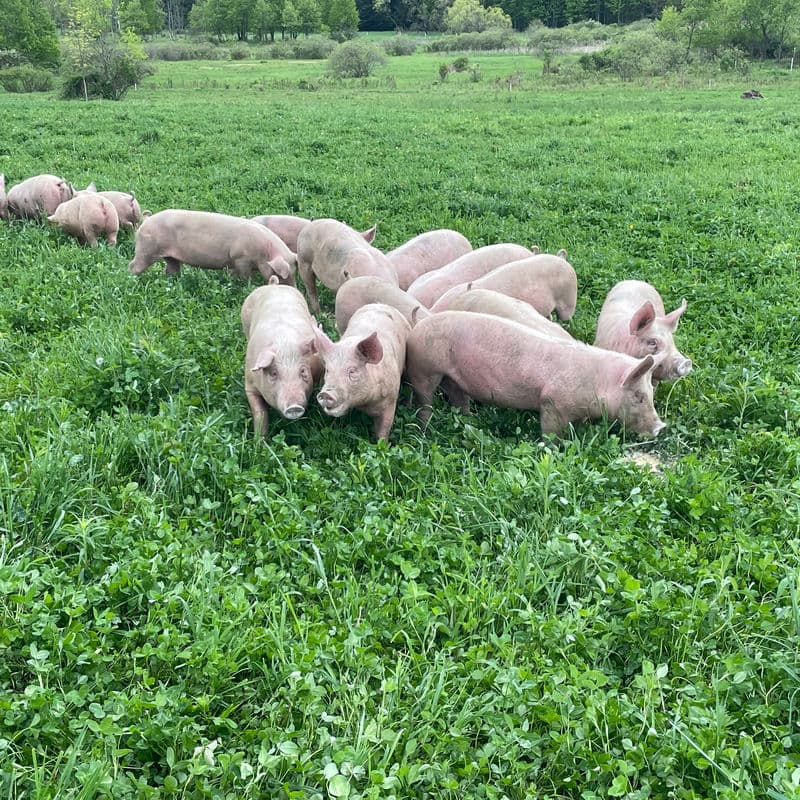
It's Our Own Cattle. The tallow in every jar of our whipped balm comes from our own grass-fed herd. We don't source tallow from outside suppliers. We don't blend in commodity beef fat. We render from suet pulled off animals we raised ourselves, on pasture, without grain finishing, without antibiotics, without hormones. We know what those cows ate, where they walked, and how they lived. That kind of traceability is almost impossible to get from a tallow product unless the company raises its own cattle. Most don't.
Wet-Rendered Five Times. Then Dry-Rendered Once. This is the part that genuinely separates our tallow from almost everything else on the market, and it's worth understanding because it explains why ours behaves differently on your skin and in the jar.
Here's what the process actually looks like.
We start with clean suet and simmer it in water for 24 to 36 hours. Long, slow, low temperature. As it cooks, the pure fat releases and floats to the surface while the impurities — meat particles, blood, connective tissue debris — sink and stay in the water. We pour the entire pot through a fine filter, then let it cool overnight. The fat hardens into a clean white block on top of the water. We lift the block out, and what's left in the pot is dirty, dark water full of suspended particulate. That's what we just pulled out of the tallow.
That's render number one.
Then we put the hardened block back into a clean pot, cover it with fresh water, and simmer it again. Filter. Cool. Separate. The water at the bottom is cleaner this time, but it still has particulate. So we do it again. And again. And again.
We don't stop at a fixed number. We stop when the water that comes out of the bottom of the pot is completely clear with zero visible particles. For our suet, that takes about five wet renders on average. Some batches need more.
Once the wet render is done, we do one final dry render. This is just gentle, dry heat — no water — to drive off any remaining moisture. The result is tallow with zero water content, zero impurities, and zero detectable beef smell.
Why This Matters for Your Skin (and Your Jar). This level of purification isn't industry standard. It's not even close to industry standard. Most tallow producers wet-render once or twice and call it done — which is why most tallow products have a faint beef smell, eventually develop a rancid edge, and require stabilizers to stay shelf-stable.
Our tallow is different. It's:
Odorless. No beefy smell. No "tallow" smell. Nothing.
Indefinitely shelf-stable without preservatives, vitamin E additions, or beeswax binders. Pure, fully-rendered tallow with zero water content does not mold, rot, or oxidize the way improperly rendered tallow does.
Pure white. The color tells you the impurities are gone.
Beautifully whippable into the cloud-soft texture you feel when you open the jar.
If you've ever tried tallow skincare and didn't love the smell or watched it turn on you after a few months, this is why. The tallow wasn't taken far enough. We don't cut that corner.
Why Tallow Belongs on Your Skin in the First Place
Beef tallow is the closest thing in nature to your own skin's sebum. Its fatty acid profile — heavy on stearic, oleic, and palmitic acids — matches the lipids your skin produces on its own. That structural similarity is why tallow absorbs cleanly without sitting on the surface, why it nourishes the skin barrier without disrupting it, and why it works for so many skin types that struggle with conventional moisturizers.
Tallow also delivers fat-soluble vitamins — A, D, E, and K — in their natural, bioavailable form, stored exactly where the body knows how to use them. Synthetic versions of these vitamins, common in conventional skincare, are not the same molecule and are not absorbed the same way.
This is also why pre-industrial cultures used animal fats on their skin for thousands of years. It worked. It still works. The only reason it fell out of favor is that the industrial seed-oil and synthetic-cosmetic industries had marketing budgets and rendered tallow didn't.
The Four Blends — What Each One Does
We offer four blends, each designed for a different skin need. With the herbal blends, the herbs are infused into the organic jojoba oil before being whipped into the tallow base, which means the active compounds are gently extracted into the oil itself rather than sitting on top as fragrance.
Plain. The original. Just our purified tallow and organic jojoba oil — nothing else. No herbs, no infusion, no scent. This is the blend to reach for if you have highly sensitive skin, react to plant compounds, or simply want the pure benefits of properly rendered tallow without any additions. It's also our recommendation for newborns, babies, and anyone introducing tallow skincare for the first time. Sometimes the best formula is the one with the fewest variables.
Coffee & Vanilla. The brightening blend. We start with our own organic, single-origin coffee — freshly roasted right here at the farm — and infuse it into the jojoba oil alongside top-grade organic Madagascar vanilla beans.
Coffee has earned its place in modern skincare for good reason: caffeine is a vasoconstrictor that temporarily tightens skin and reduces puffiness, and coffee delivers polyphenols and chlorogenic acid that work as antioxidants against the free-radical damage that drives premature aging. Vanilla brings its own deep antioxidant profile — vanillin and a broader polyphenol spectrum — along with traditional anti-inflammatory and skin-soothing properties dating back centuries.
Together, they make a balm that brightens, firms, and nourishes, with a warm, naturally rich scent that comes from whole beans and ground coffee, not from synthetic fragrance or essential oils. This is the blend to reach for in the morning, or under the eyes, or anywhere you want a gentle wake-up for your skin.
Yarrow, Lavender & Mullein. The healing blend. Yarrow has been one of the most respected wound-healing herbs in the Western herbal tradition for over two thousand years — used by ancient Greeks, Romans, Native Americans, and European folk healers for cuts, burns, and skin irritation. Modern research has documented its anti-inflammatory and skin-regenerative properties, including faster wound closure and reduced scarring.
Lavender adds over 2,500 years of skincare history — soothing redness, supporting balanced sebum production, and gently calming sensitive or reactive skin. Mullein rounds out the blend as a soothing emollient herb traditionally used for irritated, dry, or eczema-prone skin.
Together, this is the blend to reach for when your skin is broken, scraped, chapped, recovering, or simply asking for gentleness. It's also the one many pregnant and nursing mothers gravitate toward.
Turmeric, Ginger & Mullein. The anti-inflammatory blend. Turmeric has been used in skincare for thousands of years across South Asian traditions for its ability to calm redness, support an even tone, and brighten the complexion — driven by curcumin, its primary active compound. Ginger brings warming circulation support and helps reduce puffiness. Mullein is a soothing emollient herb traditionally used for irritated, dry, or eczema-prone skin. This blend is the one to reach for when your skin is flared up, inflamed, or asking for extra calm.
What We Deliberately Leave Out — and Why
Just as important as what's in the jar is what isn't. Each of these decisions is deliberate, and each one matters.
No Essential Oils. This is the one most people ask about, because nearly every "natural" skincare product on the market relies on essential oils for fragrance and claimed benefits. We don't use them, and we won't.
Here's why: essential oils are extremely concentrated plant extracts, and a meaningful number of people are sensitive to them — sometimes immediately, sometimes after months of repeated exposure (a phenomenon dermatologists call sensitization). They cause breakouts. They cause headaches. The strong odors they produce are concentrations that don't exist anywhere in nature, and the human body wasn't designed to process them at that intensity day after day.
Whole-plant herbal infusion is gentler. The active compounds transfer to the carrier oil, but at the natural concentration the plant produces them at — which is what your body recognizes. You get the benefit without the irritation, without the headache, and without the forced "spa scent" that takes over a room.
No Beeswax. Most tallow balms include beeswax as a binder and to add structure. Ours doesn't, because it isn't necessary. When tallow is properly wet- and dry-rendered to the level we render ours, it holds its structure beautifully on its own. Beeswax is a workaround for tallow that wasn't taken far enough in processing. Our whipped balm doesn't need a workaround.
No Preservatives, No Stabilizers, No Fillers. Properly rendered, water-free tallow doesn't grow bacteria. It doesn't go rancid the way oil-based products do. It doesn't need chemical preservation to stay safe and effective on a shelf for a year or more. That's why our ingredient list is five items or fewer. Anything else would be either compensating for poor processing or padding the volume to lower the production cost. We do neither.
The Jojoba Oil
One last note on the jojoba oil. We chose jojoba because it's been used in skincare for hundreds of years, it's well-tolerated by nearly every skin type, and it's one of the most reliable carrier oils for herbal infusion. It's not exotic. It's not new. It's a proven ingredient that does its job — which is to carry the herbal compounds into the tallow blend and add a touch of lightness so the balm spreads easily without feeling greasy.
That's the whole reason. Sometimes the best ingredient is the one that has worked for generations and doesn't need a marketing story.
How to Use It
A small amount goes a long way. Scoop a pea-sized portion with clean fingers, warm it between your palms until it melts (which takes seconds — your body heat is enough), and massage into clean skin. Use it on your face, hands, elbows, knees, anywhere dry, anywhere irritated. Morning, night, or as a spot treatment when you need it.
For best absorption, apply to slightly damp skin — right after a shower or after splashing your face with water. The damp skin pulls the balm in and lets it set the moisture barrier behind it.
Try It
If you've been looking for skincare that actually does what it says — without a twenty-ingredient label, without essential oils that flare up sensitive skin, without preservatives and stabilizers and synthetic fragrances — this is it. A handful of real ingredients. Real food for your skin. Made in small batches at our farm in Edinboro, Pennsylvania, from cattle we raised ourselves.
Choose your blend on our whipped tallow balm shop page. Available in 1 oz and 2 oz jars. Ships free at $55+. Have questions about which blend is right for your skin? Reach out anytime — we're always happy to help you choose.
Caleb Schenk
Owner and farmer at Deer Run Acres, a regenerative family farm in Edinboro, PA producing the healthiest food through sustainable practices.