From the soil up — what really separates our pasture-raised pork from what's sitting in the grocery store cooler.
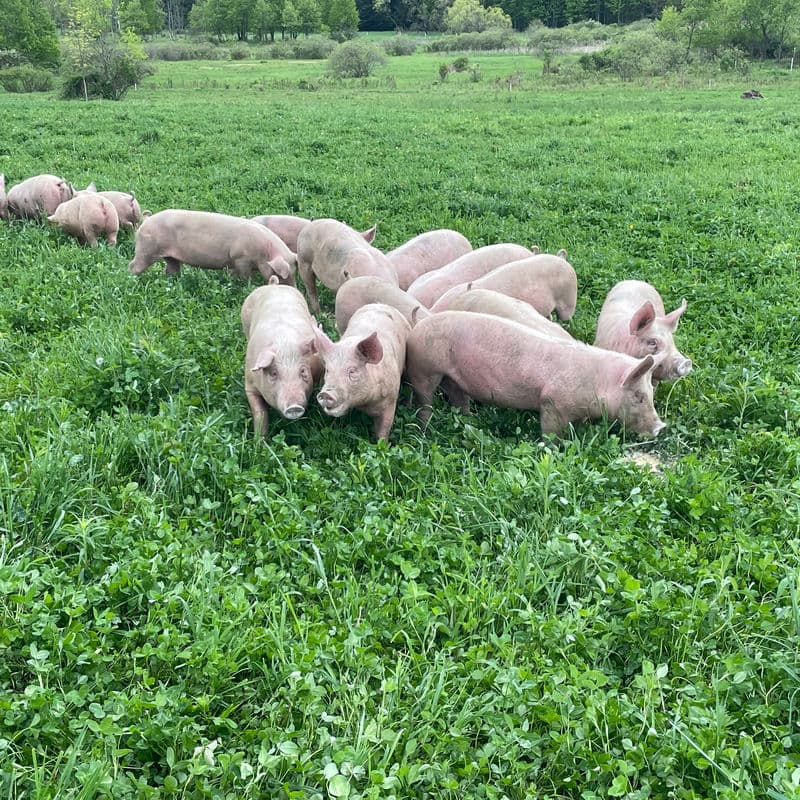
If you've never seen a pig do what a pig was actually built to do, it's hard to grasp how unnatural the modern pork industry really is. Pigs are not lazy animals. They are not dirty animals. They are intelligent, athletic foragers — built to root, to roam, to work the soil with their snouts and turn the land over while they eat. Watch one of ours for ten minutes and you'll see exactly what they were designed to be.
That's not what's happening to most of the pork sold in America. And once you understand the difference, it gets very hard to go back.
How We Actually Raise Our Pigs
Here's the honest version — start to finish.
We bring our piglets in at around eight weeks of age. For the first six weeks, they live in our high tunnel, rooting through deep compost and straw. This is their training ground. They're learning to use their snouts, building muscle, developing the strong legs and feet they'll need on pasture. By the time they're ready to go outside, they're already doing what pigs do — turning soil, digging, exploring.
Around four-and-a-half months of age, they transition to full outdoor living. From that point until slaughter — somewhere between seven and eight months total — they're on pasture. They have shade. They have shelter. They have room to run. We rotate them every few days to every week, depending on weather and how hard they're working a particular paddock. Some rotations put them on open pasture; others put them in brushy edges and woodlot, where they get a different mix of forage.
What are they eating? Clovers, forbs, grasses. Roots — dandelion, burdock, curly dock, wild carrot, whatever's underfoot. Worms, grubs, beetles, every bit of wild protein their snouts can find. And alongside all of that, a non-GMO grain ration that fills out their nutritional needs without compromising what they're getting from the land.
That diet — that life — is what builds the meat we sell.
What "Pasture-Raised" Actually Means (And Why the Label Often Doesn't)
The phrase "pasture-raised" is unregulated in the United States. There is no legal definition. A producer can put pigs on dirt for an hour a day and call it pasture-raised. They can rotate one group of pigs through a small grass yard once a week and use the same label. The marketing language has been so thoroughly diluted that most shoppers can't tell the difference between a farm doing it right and a farm doing it as window dressing.
So here's our definition. Our pigs live outside. They live on living soil, not on bare dirt or concrete or slatted floors. They move regularly to fresh ground. They have access to shade and shelter at all times. They forage actively, every day, from when they hit pasture until they're loaded for the butcher. That's the standard we hold ourselves to, and it's the standard you should expect when you buy pork that costs more than what's in the grocery cooler.
Why Living on Soil Changes the Meat
This is the part most people don't realize: where a pig lives directly changes what's in its meat.
A pig rooting through pasture is taking in nutrients you can't replicate in a feed bag. The soil itself contributes minerals. The grubs and worms contribute long-chain fats. The clovers and forbs contribute fat-soluble vitamins. The sunlight on their backs builds vitamin D in their fat tissue. None of this happens in a confinement barn.
Independent research has documented the difference. Pasture-raised pork has been measured at up to ten times the omega-3 content of conventional pork. Conventional pork tends to run an omega-6 to omega-3 ratio around 20:1, which contributes to the chronic inflammation problems showing up in modern American diets. Pasture-raised pork shifts that ratio dramatically — often cutting it in half or better. Pasture-raised pork has been measured at roughly three times the vitamin D and twice the vitamin E of conventional pork, plus higher selenium levels.
This isn't marketing language. This is what happens when an animal eats the food it evolved to eat, in the environment it evolved to live in.
The Marbling Question — And Why Our Pork Isn't Lean and Bland
You may have heard pork called "the other white meat." That phrase came out of a 1980s pork industry marketing campaign, and it kicked off forty years of breeding pigs to be leaner, faster-growing, and blander. Modern commercial pork is engineered to be lean because the industry decided that's what the American consumer wanted.
It's not what pork is supposed to be.
Our pigs grow more slowly. They live longer. They exercise constantly — running, rooting, climbing the contours of the land. That extra time and that natural movement build something the modern industry has largely lost: real intramuscular marbling. Our pork chops have ribbons of fat running through them. Our bacon has depth. Our roasts hold flavor in a way that grocery store pork simply cannot match because grocery store pigs were never given the chance to develop it.
Marbling isn't just about taste. It's about how the meat cooks, how it holds up over heat, how satisfying it is to eat. A well-marbled pasture-raised pork chop will not dry out the way a lean grocery store chop will. There's a reason chefs who cook with pasture-raised pork talk about it the way they do.
What's Actually Happening in Conventional Pork Production
This is the part of the story most people don't want to hear, but it matters. Roughly 97% of the pork sold in America comes from confinement operations — what the industry calls CAFOs, concentrated animal feeding operations. Here's what that looks like.
The Living Conditions. Pigs in confinement live their entire lives indoors. They stand on concrete or on slatted metal floors designed so manure and urine fall through into pits below. They never touch soil. They never see sunlight. They never root. Many breeding sows spend most of their adult lives in gestation crates so small they cannot turn around — a practice that has been banned in much of Europe and is being phased out by some U.S. producers, but remains widespread.
The air in these barns is thick with ammonia from accumulated waste. Respiratory disease is rampant. Tail-biting and aggression are constant problems because the animals are in unnatural conditions, so producers routinely dock tails and clip teeth in piglets to manage the behavior the system itself creates.
The Antibiotics. You cannot keep thousands of pigs alive in those conditions without constant medical intervention. Conventional pork production relies on routine, sub-therapeutic antibiotic dosing — not to treat sick animals, but to prevent the diseases that the system itself causes and to push faster growth. The American pork industry is one of the largest users of medically important antibiotics in the country, and that use is directly tied to the rise of antibiotic-resistant bacteria that affect human health.
Our pigs don't need antibiotics, because we're not creating the conditions that cause disease in the first place. Healthy animals on pasture, in fresh air, with room to move, simply don't get sick the way confinement pigs do.
Ractopamine. This one is worth knowing about. Ractopamine is a beta-agonist drug — a feed additive given to pigs in the final weeks before slaughter to push rapid muscle growth. It's estimated to be used in roughly 60 to 80 percent of U.S. pork production. It is banned or restricted in 168 countries, including the entire European Union, China, Russia, and most of the developed world. The U.S. is one of the few countries where it remains legal in pork.
The drug has been linked to lameness, broken bones, hoof disorders, and respiratory distress in the pigs receiving it. The only human safety study the FDA conducted involved six participants and was halted early when one developed a dangerous heart rate response after a single dose. Despite a decade of petitions from public health and consumer groups, the FDA has not reconsidered its approval.
If you eat conventional pork from a U.S. supermarket, the odds are very high that ractopamine is part of what you're eating. We do not use ractopamine. We never will.
The Manure Problem. In a confinement operation, all that waste from thousands of pigs has to go somewhere. It collects in massive open-air storage pits called manure lagoons — anaerobic, untreated, often the size of football fields. These lagoons release ammonia, hydrogen sulfide, and methane into surrounding air. They leach into groundwater. They overflow during storms and contaminate rivers. Communities that live near major hog confinement regions in North Carolina, Iowa, and elsewhere have documented health impacts directly tied to lagoon emissions.
Our pigs spread their own manure naturally, on pasture, where it feeds the soil that grows the next paddock. The same manure that's a toxic waste problem in confinement is a regenerative resource on our land. It's the same material — the difference is the system around it.
What's Actually In the Feed. This part surprises most people. The legal feed category called "recovered retail food" allows livestock producers to feed expired bakery goods, dairy, and other discarded human food to pigs. In practice, what this often means is that bread, pastries, and other retail surplus get ground up and fed to hogs still in their plastic packaging, because de-bagging at scale is expensive and often skipped.
Multiple investigations have documented plastic shards turning up in commercial hog feed as a direct result of this practice. The microplastic contamination then accumulates in the animals' tissue. When you buy conventional pork, you may be buying meat from animals that were fed plastic-contaminated food waste for months.
Our pigs are fed a non-GMO ration from Walnut Hill Feeds — actual feed, formulated for hogs, with traceable ingredients. No food-waste pipeline. No mystery bakery scraps. Just clean grain alongside everything they forage themselves.
What This Means for You at the Table
Pork raised the way ours is raised tastes different. It cooks different. It nourishes different. It's denser, more flavorful, more satisfying. The fat is firm and clean and renders beautifully. The meat holds its character through whatever you do with it — quick-seared chops, slow-braised roasts, smoked shoulders, breakfast sausage.
It also costs more. There is no honest way around that. A pig that lives seven to eight months on pasture, fed real feed, moved regularly, with no growth-promoting drugs or routine antibiotics, simply costs more to produce than a pig that lives four to five months on a slatted floor. We charge what it costs us to do this work the way it should be done. We're a family farm and we're not going to apologize for that.
What you're paying for is real food, raised on real land, by people you can call on the phone. You're paying for a pig that lived a good life and produced meat that's measurably better for your family's health. You're paying to opt out of a food system that has normalized things most people would refuse if they saw them clearly.
How to Get Our Pork
We sell pork by the half or whole, butchered to your specifications at a state-inspected local butcher. You work directly with the butcher on your cut sheet — chops, roasts, bacon, sausage, ham, ribs, ground, whatever you want from the animal. Pickup is at the butcher, not the farm. Half pork yields roughly 90–120 lbs hanging weight; whole pork yields roughly 180–240 lbs. Pricing is $4.75 per pound hanging weight plus butcher costs.
Our 2026 pork will be ready in summer. Pre-orders are open now on our pasture-raised pork shop page, and we sell out every season. If you want pork raised this way for your family, the best move is to reserve your half or whole today. Have questions about cuts, storage, freezer space, or anything else? Reach out anytime — we're always happy to talk through it.
Caleb Schenk
Owner and farmer at Deer Run Acres, a regenerative family farm in Edinboro, PA producing the healthiest food through sustainable practices.